Namibia Hunting Information
The Namibia Hunting Information on this page will answer most of your questions about hunting in this "hunters paradise"!
It covers the most important facts concerning Trophy Hunting in Namibia.
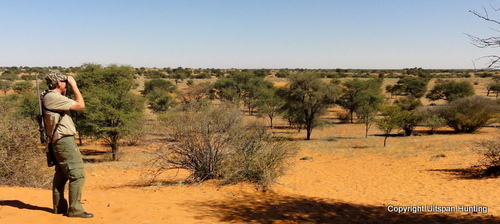
General Information
1. The Namibian Trophy Hunting season opens on February 1 and closes on November 30 of each year.
2. Clients should ensure that they are booked and will be hunting with a registered Namibian operator, as well as a registered Namibian hunting professional.
3. The three classifications of hunting professionals are:
- Hunting guides
- Master hunting guides
- Professional hunters
Two specialist qualifications are:
- Big Game Professional Hunters - registered Namibian professional hunter who has passed the Big Game examination; and
- Bow Hunting Professional Hunters - registered Namibian hunting professional with an additional bow-hunting qualification.
4. Hunting professionals should comply with all the Ministry of Environment & Tourism's (MET's) trophy-hunting regulations.
5. Trophy hunting may be practised from half an hour before sunrise, until half an hour after sunset.
6. Trophy hunting may take place only on properties where permission has been granted by the landowner.
7. Properties where bow hunting is practised must be registered additionally with MET for bow hunting.
8. The following is required regarding permits for trophy hunting:
- Permits must be issued prior to the hunt commencing;
- A separate permit must be issued for each individual hunting client;
- An extra, special permit is required for the large cats (leopard, cheetah, lion). It contains an additional list of conditions;
- A permit must be completed in full by the hunting client and the hunting professional (wounded or lost animals must also be indicated on the permit);
- Permits are issued by the MET only; and
- A maximum of two trophies per species may be harvested, per hunting client, per permit.
9. All trophy-hunting operators must be registered with the Namibia Tourism Board (NTB).
10. Dogs are not permitted whilst hunting for cheetah.
Requirements for Importing Firearms
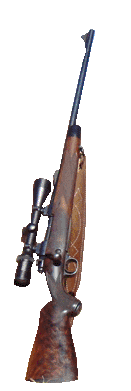
1. A maximum of one-hundred (100) rounds of ammunition may be imported per hunting rifle. Only ammunition for the specific caliber may be imported.
2. It is legal to hunt with black powder rifles in Namibia.
3. It is illegal to transport black powder and percussion caps. These can be purchased in Namibia. Inquire with your trophy-hunting operator.
4. It is legal to import bows for bow-hunting purposes. No import permit is required.
Read this article on "Guns and Ammo for your African Hunt"
Payment

1. A detailed Tax Invoice must be issued for every hunt.
2. Value-added tax (VAT) is currently 15% and must be paid on services and trophies that are not exported by the hunting operator on behalf of the client. (The VAT on trophies to be exported by the operator if accompanied with a copy of the passport of the client, the completed hunting permit and a copy of the invoice for the hunt is zero %.)
3. Please enquire what means of payment is required by your operator. (Click here to read our terms and also some tips on payments)
4. VAT is applicable on wounded game not recovered.
"African Safari Costs... what to consider"
Prohibited Practices
1. It is illegal to hunt for trophies:
- at night and/or with an artificial light;
- that do not qualify in terms of the minimum measurement requirements as specified by the MET, Namibian Quality Control. If trophies do not meet this requirement, they do not have to be paid for. Exceptions are trophies with abnormalities and age deformities, which are taken home by the client; and
- in contravention of the Fair Chase principals as stated in the NAPHA Code of Conduct.
The immediate export of trophies from Namibia is possible only with a veterinary certificate, an export permit from the MET and the import permit as required by the country of final destination.
2. Prohibited firearms are
- All handguns
- All automatic firearms
- All crossbows
Traveling with Firearms to Namibia
Air Travel Tips... for hunters to Africa
1. Take out full insurance for all firearms before travelling anywhere in Africa.
2. We recommend that you fly directly from Europe to Namibia into Hosea Kutako International Airport near Windhoek. This will minimise delays associated with firearm transport. Air Namibia offers a direct service.
3. Recent regulations have made travelling with firearms a time-consuming process when entering South Africa. Make sure that you stay in transit with your luggage.
4. It is suggested that you adhere to the following procedure to minimise problems when travelling with firearms:
- All bags need to be adequately marked with nametags for identification;
- Pack an unloaded rifle in a sturdy carry case;
- Have a separate lockable container in which to store your ammunition separate from your rifle in your checked luggage;
- At the check-in counter at the point of departure, insist that the agent check your firearm through to Hosea Kutako International Airport, Windhoek.
- Windhoek Airport's International baggage code is WDH; and
- Physically check baggage tag to ensure that it has been correctly printed and attached. Inquire if a colourful 'in transit tag' is necessary when travelling through another country.
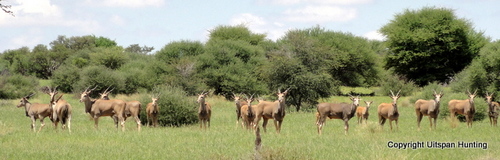
We hope that you find the above-mentioned Namibia hunting information informational.
See what other hunters to the Kalahari region in Namibia had to say...
For any other enquiries, contact us.
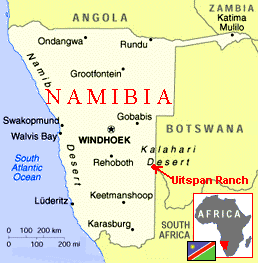
All the necessary detail on hunting with us on Uitspan Ranch, Namibia, can be find at our Hunting Info page.
Quick Links to other pages on our site...

Site Search
Did you know?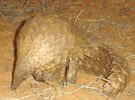 Pangolins have poor sight and do not have any external ears, although their hearing is very good. Their sense of scent is well developed and they locate ants nests by smell. |

Meaning of "Uitspan"
'Uitspan' is an Afrikaans word that means place of rest.
When the Boer settlers moved inland in Southern Africa in the 1800's, they used ox carts. When they found a spot with game, water and green grass, they arranged their ox carts into a circular laager for protection against wild animals and stopped for a rest.
They referred to such an action of relaxation for man and beast, as Uitspan.
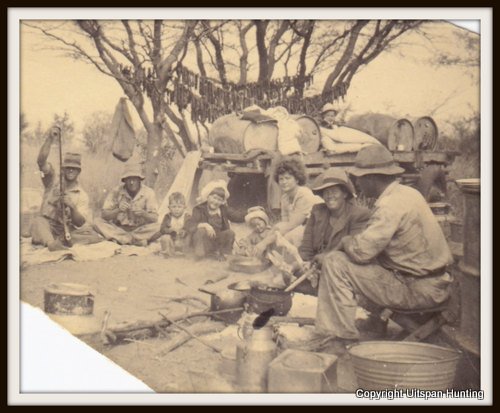
(Picture above of our ancestors.)
Did you know?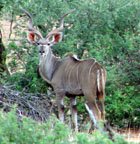 Greater Southern Kudus are famous for their ability to jump high fences. A 2 m (6.56 ft) fence is easily jumped while a 3 m (9.84 ft) high fence is jumped spontaneously. These strong jumpers are known to jump up to 3.5 m (11.48 ft) under stress. |
to read about my experience...
Did you know?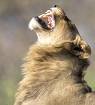 Some animals have one sense more than man!The flehmen response is a particular type of curling of the upper lip in ungulates, felids and many other mammals. This action facilitates the transfer of pheromones and other scents into the vomeronasal organ, also called the Jacobson's Organ. Some animals have one sense more than man!The flehmen response is a particular type of curling of the upper lip in ungulates, felids and many other mammals. This action facilitates the transfer of pheromones and other scents into the vomeronasal organ, also called the Jacobson's Organ.This behavior allows animals to detect scents (for example from urine) of other members of their species or clues to the presence of prey. Flehming allows the animals to determine several factors, including the presence or absence of estrus, the physiological state of the animal, and how long ago the animal passed by. This particular response is recognizable in males when smelling the urine of a females in heat. |