The Kalahari Desert
The Kalahari Desert... Where is the “real” Kalahari Desert? What does the word mean? Is it really a desert? What is so unique about the area?
Geographically the name is applied in a very loose sense. The area covered by Kalahari sands extends over some 2.5 million km² of the interior of central southern Africa.
These wind-blown sands are the largest continuous stretch of sand in the world. The area constituting in the Kalahari dune veld is but a small part, in the south-westhern corner of this vast expanse, and includes the extensive sheet of aeolian sand of south-western Botswana, together with the adjacent areas of Namibia and South Africa.
This region is characterized by long sand dunes running in parallel rows, in a northwest-southeast direction, and rising in places some 15-30 m above the dune valleys or "streets" between them.
"The term Kalahari is a corruption of the word ‘Kgalagadi’, the name of a black tribe who inhabit Botswana.
In the Setswana language the word means ‘always dry’, although the
meaning of the word has been interpreted in a variety of other ways,
such as 'wilderness', 'thirstland', 'the land that has dried up' or 'salt pans. "
(Noel van Rooyen, Flowering Plants of the Kalahari Dunes).
"The Kalahari is not a true desert but rather an arid savanna and is quite densely covered with grasses, shrubs and trees. It is regarded as one of Africa’s last wilderness areas and is probably one of the largest relatively undisturbed arid savannas in Africa. Inaccessibility, the lack of prominent landmarks and the lack of surface water for most of the year, have contributed to minimal human impact and the preservation of the area.
As a tourist destination, the Kalahari has always been unique. Besides the presence of game, the remoteness and sense of wilderness will always attract the appreciative visitor to the area."
The Kalahari Basin and the Kalahari Desert
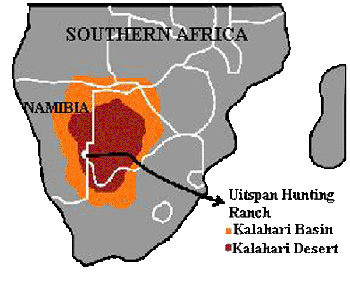
One often reads about the "Kalahari Basin". This definition applies to the bigger area covered by sand which extends across much of south-central Africa.
Another characteristic of this Basin, is the fact that most of it forms a flat plain with an average elevation of 1000m (3000 ft) above sea level. All of dry riverbeds, dusty plains, dune-belts and rather flat, undulating areas are to be found in this huge area.
Within this Kalahari Basin is a much smaller area known to all as the Kalahari Desert. The southern part of this is the driest and conforms most closely to the image of a true desert.
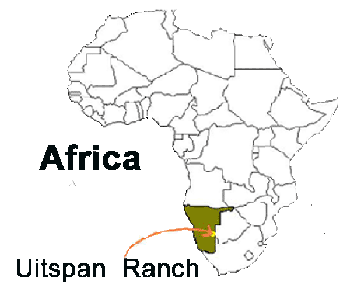
This is where our family live.
This is where we share our love for nature, the outdoors and hunting - with special people.
Read a review on hunting and travelling in Namibia!
Habitats
Nature here consists of different habitats. It differs from red, rolling dune belts near the Nossob river (actually an ancient dry riverbed) just southwest of our ranch, to the soft undulating dunes covered by vegetation.
Another habitat is the enormous pans.
These pans are shallow depressions with different sizes and shapes and covered by smooth, hard clay. Two types of pans can be find, namely the ones with bare, whitish surfaces and the other covered with grass.
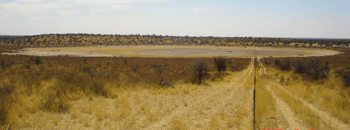
Most of the time, these pans are dry. This first picture shows how it usually looks from a distance. For the animals, these pans are sources of mineral salts.
During rainy seasons, water are captured and held (sometimes as long as months) in these natural "drainage basins". The surface of the pans then turns slibbery and muddy. Animals gather in numbers at these pans since in some places in the Kalahari Desert, it is the only surface water available in long months.
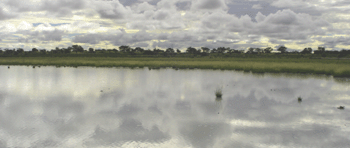
It is not only animals that gather here during rainy seasons. We that live here, often experience drought cycles as extremely debilitating and exhausting. We are just as happy, glad and thankful when rain arrives. And with this joyful feelings, we then go to the pans and celebrate by playing in the wet clay.
The end of it is that everyone is covered in sticky, white clay from head to toe. Well, we never have snowballs to throw at one another, but we have clay-clods and there surely is no better way of celebrating RAIN!
Different 'outfits' of the Kalahari Desert
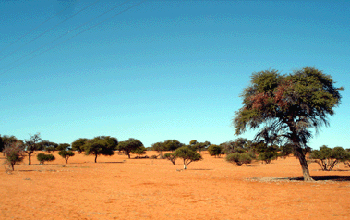
Droughts are more the normal condition here than otherwise. Then the land becomes harsh and unforgiving and seemingly comatose under this hot African sun. It is very sad to see the region in this “outfit” wherein plants and animals suffer and where carcasses and skeletons often litter the red sand.
This reality about the Kalahari Desert has a certain effect on the animals and people that struggle and survive here. It makes them resilient, resourceful and self-reliant.
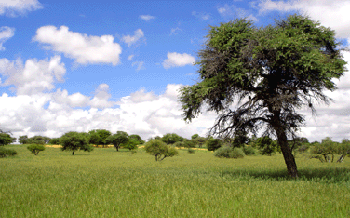
Rain, however, fits the same region out in a colorful, vivacious “dress”. The countryside is transformed and red arid sand gives way to bright green grass. Trees and shrubs, covered by dust before, are clean and fresh.
Rain gives the Kalahari Desert a whole new personality. These favorable conditions for feeding, breeding, growing and reproducing are so short and long apart; every living creature seems to seize the moment!
Drought or rain; cloudy of sunny; warm or cold; morning, noon or night.... Nature here has a variety of faces: some you can see easily, but only the perceptive and appreciative visitor finds the gems and the jewelry of the Kalahari Desert.
So, when you ever visit here, be on the lookout for the qualities and skills of the plants and animals, for the depths of color observable.... and for the lessons to be learnt here.
These are the real, most valuable and precious trophies and they are priceless!
Read more and see our video about the scaly pangolin in the Kalahari.

Site Search
Did you know? Pangolins have poor sight and do not have any external ears, although their hearing is very good. Their sense of scent is well developed and they locate ants nests by smell. |

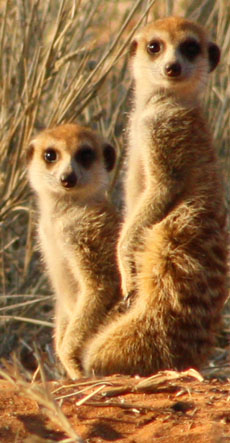
Meaning of "Uitspan"
'Uitspan' is an Afrikaans word that means place of rest.
When the Boer settlers moved inland in Southern Africa in the 1800's, they used ox carts. When they found a spot with game, water and green grass, they arranged their ox carts into a circular laager for protection against wild animals and stopped for a rest.
They referred to such an action of relaxation for man and beast, as Uitspan.
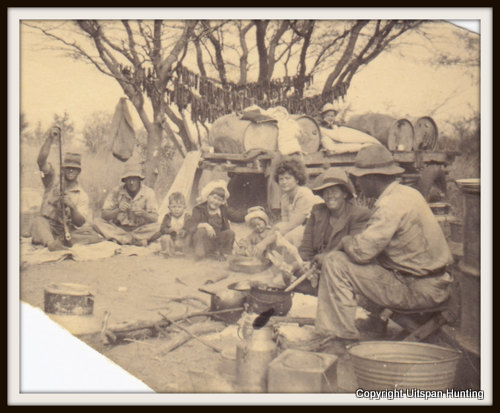
(Picture above of our ancestors.)
Did you know? Greater Southern Kudus are famous for their ability to jump high fences. A 2 m (6.56 ft) fence is easily jumped while a 3 m (9.84 ft) high fence is jumped spontaneously. These strong jumpers are known to jump up to 3.5 m (11.48 ft) under stress. |
to read about my experience...
Did you know?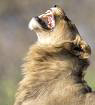 Some animals have one sense more than man!The flehmen response is a particular type of curling of the upper lip in ungulates, felids and many other mammals. This action facilitates the transfer of pheromones and other scents into the vomeronasal organ, also called the Jacobson's Organ. Some animals have one sense more than man!The flehmen response is a particular type of curling of the upper lip in ungulates, felids and many other mammals. This action facilitates the transfer of pheromones and other scents into the vomeronasal organ, also called the Jacobson's Organ.This behavior allows animals to detect scents (for example from urine) of other members of their species or clues to the presence of prey. Flehming allows the animals to determine several factors, including the presence or absence of estrus, the physiological state of the animal, and how long ago the animal passed by. This particular response is recognizable in males when smelling the urine of a females in heat. |